SBU / AreshEarth Tree Pit Project
Three Site Clusters
Lincoln Ave & 137th St — 5 beds. Perennials confirmed, willows in barrels, future park vision.
137th between St. Ann's & Cypress — 3 beds. Shade shrubs, Black Locust guards, resident stewardship.
St. Ann's Ave near Rec Center & PS 277 — 2 beds. Newly plantable bus stop pit, PS 277 learning bed.
2490 3rd Ave spigot — primary. 147 Lincoln Ave — pending outreach.
- SBU office meeting — project scope, site selectionMay 7
- Friday fieldwork — Door group, cobblestone clearing, Maria Sola pathsMay 9
- City agency email thread — Jada, Julia Eiferman, K.C. Alvey, Jessica EinhornMay 15–19
- Site walkthrough with Vernon (Parks Forestry) — all 3 clusters assessedMay 26
- June 4 LAC planting day — ~30 participants, perennials + willows + mulch + fencingJune 4
- Next group meeting — debrief June 4, review cluster 2 & 3 progress, design reviewTBD — schedule nowFull team
- Confirm building spigot access at 2490 3rd Ave + outreach to 147 Lincoln AveASAPAresh / Jada
- Mark up nursery availability spreadsheet — return to Jessica EinhornThis weekJada & Matthew
- Initiate DEP track for magnetic hydrant cap replacement on Lincoln Ave & 137thOngoingJada / Aresh
- PS 277 outreach — initiate school learning bed partnershipCluster 3 next phaseJada
- Cluster 2 planting session — Mill Brook HousesSummer 2026
- Cluster 3 planting — St. Ann's bus pit + PS 277 learning bedSummer 2026
- Mott Haven Community Garden Coalition — first monthly workdayLast Sunday of month, TBD
The team convened to launch the Tree Pit Project: a plan to reactivate 51 empty "unplantable" tree beds identified by NYC Parks (Jessica Einhorn) as unsuitable for trees but available for shrubs, perennials, and creative greening. Matthew's introduction to the unplantable bed list through Bronx's Blooming and the Forest for All coalition opened the lane. Rather than a limitation, 51 empty beds became the site of possibility.
The group filtered to 27 beds within the SBU catchment south of E 149th Street, conducted a preliminary ground-truthing survey, and landed on 10 priority pits for Phase 1 activation.
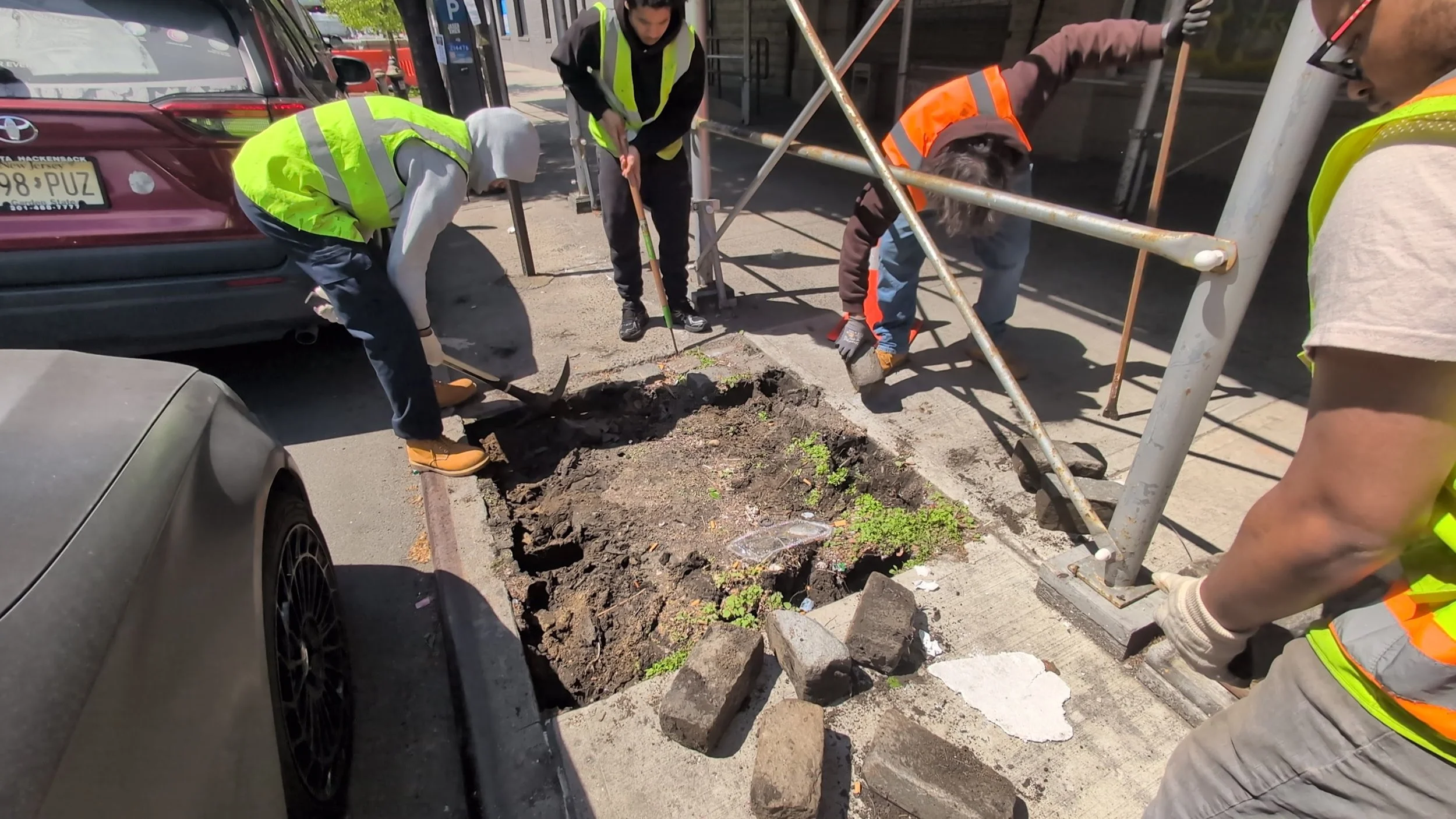
Since the meeting, Aresh and the Door group worked alongside David, Grant, Maxine, and George, as well as three Rise Up! Forest the Bronx summer camp families. Cleared cobblestones from 3 beds on Lincoln Ave (bank side) and 1 bed at 135th & Lincoln; added wood chips to all four. Put up the Maria Sola tent for rain activities; set up cobblestone-and-rope pathways. Secured permission for a dedicated outreach action area at Maria Sola and for the Semilla Pocket Park creation.
May 15–19: Jada initiates city agency email thread with Julia Eiferman (City Hall), K.C. Alvey (Climate), Jessica Einhorn (Parks) — nursery plants, ADA vetting, walking tour coordination
May 21 (Thu): Next full group meeting, SBU, 2:00 PM
May 26 (Tue): Site walkthrough with Vernon from Parks Forestry → see Document 02
- Aresh coordinated with Jennifer Hernandez (DOT Furniture)
- Aresh regenerated 3 tree pits by Lincoln Ave bank side
- Jada: physical walkthrough with Parks Tree Pit Unit (led to May 26 walkthrough)
- Jada: ask Mychal for introduction to incoming bank at Lincoln Triangle
- Jada: add site map or Google Maps link to shared workspace
- Matthew & Jada: continue refining map and site parameters
The full team met Vernon from NYC Parks Forestry at Maria Sola and drove together through all three clusters. Vernon examined each bed, explaining unplantable designations, assessing suitability for shrubs and perennials, and noting what the community can and cannot install without permits. A rare, generous, on-the-ground collaboration.
- One bed confirmed plantable for perennials now. Two larger beds held for trees once scaffolding comes down (~1 year).
- The tree at this site is an American Elm — if it survives, it will eventually be larger than any tree visible in the surrounding area. Plantings and fencing directly support its survival.
- Elongated bed / bioswale opportunity: beds could join into one long configuration for storm water capture. DEP jurisdiction; flag for future coordination.
- Willow installations: in barrels rather than in-ground at the most constrained corner (DOT pedestrian pathway concern).
- Long-term community park vision confirmed — Vernon open to partnership with LAC. Council member connection may unlock capital project funding.
- Pit 1 (north side, near street light): resident stewardship anchor — identify building contact.
- Pit 2 (south side, top of hill): angled cars backing into pit. Large tree canopy overhead. Plant small shade-tolerant shrubs toward the back. Requires metal or thick Black Locust guard — vehicle impact resistance is essential.
- Corner of 137th & Cypress: released from Phase 1 scope. Car rental operation makes it too high-effort for now.
- Bus station pit (St. Ann's near 138th, east side): newly plantable under new DOT rules this month. Sturdy metal guard in place. Parks updated its records.
- Vernon's suggestion: offer community and local businesses several tree species choices for this pit — the incoming tree should be welcomed, not imposed.
- Two rec center-adjacent beds: large trees overhead with drip lines extending over the pits. Possibly shift south as drip lines recede. Vernon took photos.
- PS 277 pit: good conditions for a school-led learning bed — shrubs, willow elements, open experimentation with children.
- Vernon's pace guidance: very hardy shrubs first, one block at a time. Don't do everything at once.
FDNY Engine 60 / Ladder 17 · 341 E 143rd St · (718) 430-0260
For standard (non-magnetic) hydrants: visit in person with Parks planting permits, speak with On-Duty Captain, request spray cap installation. Best time: 9–11:30 AM on a weekday.
Primary water source confirmed: Building spigot at 2490 3rd Ave, Bronx NY 10454. A 200-ft hose reaches the willow plantings at Graham Triangle. Outreach needed to building management to confirm access.
The Local Action Committee meeting became the first community planting event. Starting at Maria Sola with Jada's framing of the project's ecological and community sovereignty roots, the group walked to Graham Triangle. Three planting teams worked in parallel: two perennial groups (Javier and Aresh) and one willow group (Aresh). Kayla performed music during the planting. Documentation was shared in real time.
The session followed a living arc: gather and frame → prep tools and mulch → walk to the beds → trash pick → weed pull (with composting education) → soil amendment with compost and coffee grounds → plant → mulch to 3 inches → install rope-and-post perimeter fencing → chalk mapping of future green space.
- Trash cleared from all three beds before planting
- Weeds pulled with full roots — organic material composted separately (educational moment on dandelion root systems and soil health)
- Compost and coffee grounds (high nitrogen) mixed into pit soil
- Native perennials planted in confirmed beds
- Willow stakes planted in the willow zone — pre-cut at angle at base for planting
- 3 inches of mulch applied across all three pits (~11 wheelbarrow loads) to lock in moisture against summer desiccation (Vernon's recommendation)
- Rope-and-post perimeter fencing installed around all beds — deters dogs and foot traffic
- Chalk mapping of future green space at Graham Triangle drawn on sidewalk
- FDNY Engine 60 visited — confirmed magnetic caps are DEP-managed (key water logistics finding)
- Have more wheelbarrows (or use large wagon more centrally) — 11 loads across 3 pits stretched 3 barrows thin
- Fix or replace the wheelbarrow with missing wheel screw before next session
- Secure water access at 2490 3rd Ave before next planting session
- Produce design concept flyers (willow / native understory / standard guard) for community selection
- Schedule next group meeting to debrief, review cluster 2 & 3 sites, and set watering stewardship assignments
🌿 Native Planting Guide for Tree Pits
Plant selections for each pit are developed based on light levels, pit size, surrounding conditions, and available nursery stock. Source: NYC Parks "Planting Flowers and Shrubs" page.
- Select the toughest cultivars available — especially at Cluster 1 and 2 where summer heat and parking pressure are severe
- Apply 3 inches of mulch to all beds after planting to lock in moisture (Vernon's recommendation)
- For Cluster 2 south side: shade-tolerant shrubs only, positioned toward the back of the pit away from backing cars
- Citywide Nursery at Van Cortlandt Park: plant materials confirmed available. Mark up the "availability list" tab in the Jessica Einhorn spreadsheet and coordinate pickup.
🔨 Tree Guard Creation Guide
Four design concepts for Mott Haven street conditions. All designs must maintain NYC Parks water infiltration requirements and 18-inch trunk clearance minimum.
🛡 Tree Pit Urine Deflection System
Sloped Base Gutter — Engineering Detail
A sloped base gutter using corrugated plexi or half-cut clear plastic bottles diverts urine and runoff away from tree roots by harnessing NYC sidewalk drainage pitch (¼ inch per foot toward the curb). The system is self-cleaning: rainfall flushes the entire assembly automatically. All hardware sits inside the tree pit fence, reducing tripping hazard.
- Base channel: Slice 2-liter seltzer bottles lengthwise into deep half-pipes. Keep factory-molded bottom caps intact as natural end-caps at outer ends.
- Surface prep: Clean plastic joints thoroughly. Scuff overlapping edges with sandpaper — gives adhesive a surface to grip against NYC street grit and oils.
- Adhesive: 100% silicone sealant (clear outdoor window/door grade) or Loctite Marine PL. Avoid rigid glues — they crack under foot traffic and temperature shifts. Silicone stays flexible and waterproof.
- Set pitch and anchor: Lay assembled gutter along the sidewalk edge of the pit frame, angled slightly toward the street. Secure with stainless steel hose clamps or heavy zip ties to low border stakes.
- Drip edge: Vertical wall panels hang ½ inch inside the lower gutter channel without touching the bottom — fluid drops cleanly off the panel edge into the trough center, with no wicking back into soil.
💧 Watering Protocol
Secondary: 147 Lincoln Ave (between Lincoln & 3rd Ave) — Spigot scouted. Outreach to building needed.
Long-term: DEP hydrant track — Magnetic-cap hydrants on this block are DEP-managed. Initiate DEP contact to request standard cap replacement. FDNY Engine 60 cannot assist with magnetic cap removal.
📋 Materials List
- Tools: 3 wheelbarrows (repair screw on the wheel), 1 large wagon for mulch transport, shovels, pitchforks, hand trowels, gloves
- Mulch: ~11 wheelbarrow loads per 3-pit session. Pre-load wagon; distribute from central point.
- Soil amendments: Compost + coffee grounds (high nitrogen) mixed into pit soil before planting
- Plants: Native shrubs and perennials (from Citywide Nursery, Van Cortlandt Park); willow stakes pre-cut at angle at base
- Fencing: Rope-and-post perimeter materials (posts + natural rope, low-impact and removable)
- Compost bags: Separate from trash — organic material composted, not landfilled
- Chalk: Sidewalk chalk for community mapping and future green space sketching
- Fabrication (guards/benches): 316L marine-grade stainless steel hardware, EPDM gaskets, nano-ceramic anti-graffiti coating; coordinate with Yin To on plasma cutter files
- Urine deflection system: 2-liter bottles (sliced half-pipe), 100% silicone sealant, stainless steel hose clamps or zip ties